Showing posts with label Book Series. Show all posts

Friday, June 27, 2025

The Magickers Overview

 The Magickers by Emily Drake

This post will contain spoilers for all 5 books contained in The Magickers series. You have been warned.

It has been a hot minute since I did a Series Overview, but I have THOUGHTS about The Magickers. First and foremost: "The Magickers is America's answer to the Harry Potter series" says the blurb from BookBrowser on the back of two of these novels. Harry Potter this is definitely not. The Magickers probably wishes it were Harry Potter... well... without Rowling, of course. Fuck her. The point is: The Magickers is nowhere near as well written or thought-out as the Harry Potter series is. I'm not going to be comparing them one-to-one, or at all really, but I feel this needed to be said. Is The Magickers a good substitute for Harry Potter, if you're looking to not introduce your kids to it? I would say no. Pick up something by Tamora Pierce or Diane Duane's Young Wizards instead. Or maybe just The Magickers and leave the rest of the series alone.

So, why do I say all this? Well... The Magickers starts out with a very good concept of bringing magical/potentially magical kids to a camp and teaching them the ways of the Magickers. Great concept, ultimately poor execution. In my reviews, I'm pretty sure I blamed this on Gavan, but Gavan is really a stand-in for Ms. Drake herself in that regard. Like, yes, magic schools are a good idea, but it really only works if you can actually get one up and running, which ultimately does not come to pass throughout this series. A grand total of 3 teachers and 7 students does not a functioning school make, even if there's a completed building in an alternate reality.

The antagonists also aren't very antagonistic, really. First, Brennard and his "Dark Hand" are just kind of around, sometimes sucking the magic out of other Magickers because apparently magic is a finite resource? Brennard's position is very clear, but his methods to try and lure Jason in particular over to his side make zero sense. His son, Jonnard, is more threatening, but also just kind of sitting off in the background. Once he manages to actually get enough "Power" to become a threat, he's not so much the threat as the stuff coming out of the proverbial "Gate of Bones" that he manages to open. Isabella isn't much of a threat at all, or at least, not an active one. Sure, she has the Leucators, but those are also just kind of meh. They sound threatening, but in action... they're locked-up zombies who are no real threat to anyone they're not either biting or draining magic from. And then there's Mr. Nothing-Burger Eyomani. Yawn. Honestly, the wolfjackals in the first two books are far more threatening than anything else and even they turn out to be less antagonistic than at first glance. Oh, speaking of wolfjackals, Statler Finch in The Curse of Arkady was more menacing than pretty much all the rest of the antagonists combined. Fuck that pseudo-psychology "the victim is really to blame for the bullying" shit all the way off.

There's also this big, over-arching threat of the government finding out that Magickers exist. Except... there's a lot of lip service paid to this and zero action. There's a blip of a moment when Henry is confronted by a school official from the school he attended pre-Gate Opening, but that's it. Just a lot of "we can't go back home because we'll be dissected by government scientists" followed by nothing.

Oh, and the whole "Auntie Freyah is hiding Gregory's sleeping body but he can't be awoken yet" thing that turns into nothing, too. I just... I was hoping The Prince of Nowhere would resolve this, but there is nary a mention of it. I'm kind of annoyed about that whole thing, if I'm honest. However, at this point, I also don't care enough to continue even if there were more of a continuation. 

I do give The Magickers a couple of points for diversity. There's Anita Patel and Tomaz Crowfeather representing Indian and Native Americans respectively. Ting and her grandmother represent Chinese American immigrants. Aaaand Bailey and Trent both come from single-parents homes while Gatekeeper Jason is the specialist of all with two dead parents and two step-parents. Everyone who's not white feels very stereotypical of their particular POC-ness, though. I guess that's not necessarily a bad thing, but it's there and I noticed so... yeah. That is all I'm going to say about it, though, because I am a white woman and I feel like I'm going to say the wrong thing (if I haven't already) so... yup. Shutting up about that now. 

All this really makes it sound like I didn't like The Magickers, huh? Well, I enjoyed it enough. I am, admittedly, well out of the age range this series is aimed at, but... well... other Young Adult series have held up much better than this one did. I am just really frustrated with the series as a whole. It started out great. The Magickers is really good. Everything after that... not as much. The series as a whole feels aimless, even though there's a clear goal presented. After all, Jason gets the Gates to Haven open and they get the school built, but then... nothing really happens. And again, a school isn't really a school if there are only 3 teachers (2, at the very end because Tomaz is going off again) and 7 students. There are also really nice concepts here. I like the crystals. I like the dragons. I like the "everyone has an individual talent on top of just being a Magicker" thing. I like Haven. But taking all the concepts and shaking them around doesn't make them mesh together super well. The magic system ultimately leaves a lot to be desired.

I will also say that I really like the characters. I kind of wish there had been a POV book for each of them, kind of like how The Magickers was for Jason. The meshing of the ensemble cast gave us a glimpse of each person's personality and home-life, but really left me wanting more. It also made some of the books feel choppier due to a lack of cohesion of person and place, if that makes sense.

I think I'm out of talking-points now. If you're interested in my thoughts on the other books, there are links to the reviews on the "Review List" page. There's even a list on one of them about why I'm annoyed at Gavan specifically. I definitely recommend giving The Magickers, specifically, a read. It's definitely my favorite of the five.

Friday, September 27, 2024

Cainsville Overview

Cainsville by Kelley Armstrong


This post will contain spoilers for the entire Cainsville series, including all but one short-story and the novellas. You have been warned.

Cainsville was one of the few series in my life I managed to pick up as it was initially coming out. I followed it, apparently, right up until the last book (Rituals). I'm not sure how I managed to miss it at the time, but I did. I am happy to say that I have now finished the entire series and am mostly satisfied with how it turned out.

I was initially drawn to Cainsville because I very much enjoyed Kelley Armstrong's Women of the Otherworld/Otherworld series and because the the Fae element. I haven't read many books or series with a strong Fae element thus far so I was excited to see where all this went. I was initially happy with the amount of Fae lore dropped in among the human mystery parts of the story, though that waned as the series went on. The Fae stuff was still there, it just wasn't as present or otherwise just disappointing. Honestly, the addition of the sluagh as the over-arching "Big Bad" of the series just tanked the ending for me. The sluagh turned out to be some connecting tissue that probably could have been more fleshed out, but just wasn't. While I was kind of wondering what exactly possessed Patrick to actually father Gabriel, I wasn't going to be fussed never finding out.

If you've read my reviews, you'll also know that I'm not a fan of the romance elements. Or rather, not a fan of the love triangle stuff. I liked Ricky and Olivia together, but I'm definitely not a fan of Gabriel and Olivia being end-game. I personally feel like a more polygamous bent to their relationship would have made more sense. That's not to say strong friendships shouldn't be valued or cultivated, as Olivia and Ricky's is, just that... I dunno, would have felt neater from a story perspective. Also, I really do feel like Gabriel feels more asexual than not. I'm an very aware that, like most things and especially sexuality, asexuality is a spectrum and Gabriel definitely fits with some of what I've experienced personally with my own asexuality... just... the way his relationship with Olivia progresses feels weird to me. I'm not sure exactly how to explain it, but it definitely feels like Gabriel should have been fine being the friend in this forced love-triangle thing. (I will talk more about that, I promise.) It didn't seem like he had any romantic feelings in Olivia's direction until the plot and the ghost of Gwynn demanded it. I'm just not a fan of how that all worked out.

So, speaking of Gwynn... I'm also not a fan of how this ridiculousness for coded into the Fae storyline. We've got the Tylwyth Teg vs the Cŵn Annwn. Gwynn vs Arawn over the affections of Matilda. That's the whole impetus for the entirety of Cainsville, ultimately. Welsh Fae nonsense, basically. (I say that affectionately, really.) So, basically, back in ye olden times, before humans were in any sort of power in Wales, this Fae Prince of the Tylwyth Teg (Gwynn) and the Lord of the Underworld, Leader of the Cŵn Annwn (Arawn) make a pact not to try and win the affections of their mutual friend who has blood from both their lineages (Matilda). Really, in the text, it's Arawn who decides this needs to be a pact and Gwynn just goes along with it for... reasons? They do not tell Matilda about this pact. Later on down the line, Matilda makes her affections for Gwynn clear to him and they plan to marry, but do not breathe a word of this to their "bestie" Arawn... for reasons? Arawn finds out at pretty much the last minute and confronts Gwynn about their "pact." Arawn decides to tell Gwynn that if Matilda comes to him on the night before their wedding, she's now Arawn's. A new "pact" is formed, apparently. They tell Matilda none of this. Gwynn does not try to stop her from going to Arawn. Weird magic happens and not only does Matilda lose Gwynn and the Tylwyth Teg, she dies. Neither man gets what he wanted... and they are now doomed to reincarnate over and over to replay this nonsense. Whoever the Matilda chooses, gets her magical power for that generation... or something. That part was a little unclear. Also unclear exactly why a two-way split couldn't just work, even though that's what ends up happening at the end of the series. What is very clear is that Arawn is an asshole.

So, Olivia is the Matilda, Ricky is the Arawn, and Gabriel is the Gwynn of this generation. Olivia is told by the Cainsville elders that she must choose which of these men she's going to be with because weird magic nonsense. This three-some is unhappy about this and basically end up dithering until a weird third-party magic "race" (the sluagh I mentioned earlier) enters the fray in Rituals. Oh, and neither the Tylwyth Teg nor the Cŵn Annwn want to give Olivia and information about themselves until she decides to let them start courting her. Again, this whole thing could have been solved by a "Persephone solution" as Olivia puts it... and is, at the very end.

But yeah, I'm not at all salty about any of this. And to be clear, none of this made me not enjoy the story. I did enjoy the ride... mostly. I think the whole situation is very silly and obviously spawned by an idiot teenager. This is in the text of the books, by the way, I'm not making that bit up. Arawn was an idiot teenager at the time the original "pacts" were made. It's just amazing they got turned into such a big thing, magically speaking.

Outside of the Welsh Fae stuff, there is a bit of outside Fae stuff. Greek Fae, to be precise. Lamiae and Dryads make an appearance. I very much liked the inclusion of something other than Welsh Fae. Wish there had been more. I'm pretty sure the Cainsville series wouldn't really have supported adding in more mythologies, given how insular Cainsville itself is, but... eh. That's me with my global mythology interest wanting what I can't have.

I liked the original spooky supernatural mystery vibe of Omens. That definitely drew me into the series. However, that vibe definitely decreased as the series went on. Olivia did very little omen-sensing after Omens. That ability was largely discarded in favor of visions, granted by some kind of generational Fae memory. The love-triangle thing took center stage, even with the "mystery of the book" happening outside of it.

I did this read-through chronologically, as I've been doing with series lately, and I feel like the short stories did add something to the overall series. However, the novellas were largely just a revisiting of the characters and their emotional states. With the short stories, we got looks at characters outside of the whole "Matilda" thing but still within the realm of the Fae/human interbreeding and what can happen with that. We got a glimpse of Patrick pre-Omens, Gabriel's childhood, and what TC was up to. I quite enjoyed these short stories. The novellas... I could honestly reread Cainsville quite happily leaving them out. As I've said before, they really just rehash Oliva and Gabriel's feelings on what they're going through and have been through. The last two, while slightly interesting in that they explore a bit of what happens after Rituals, don't really bring much to the table, in my opinion.

I realize a lot of what I've discussed here sounds quite negative. It probably is. However, Cainsville is quite well done overall and entertaining to boot. I really do enjoy it. I just have a heavy eye-rolling kind of feeling toward certain elements... obviously. I wouldn't have so much to say if Cainsville was boring, after all.

Very last note: The novellas include some art depicting certain scenes contained within them. They're... interesting. Mostly okay, but honestly, they make Olivia look a couple decades older than 24. I also don't think the illustrations really add anything to the stories.

Monday, February 5, 2024

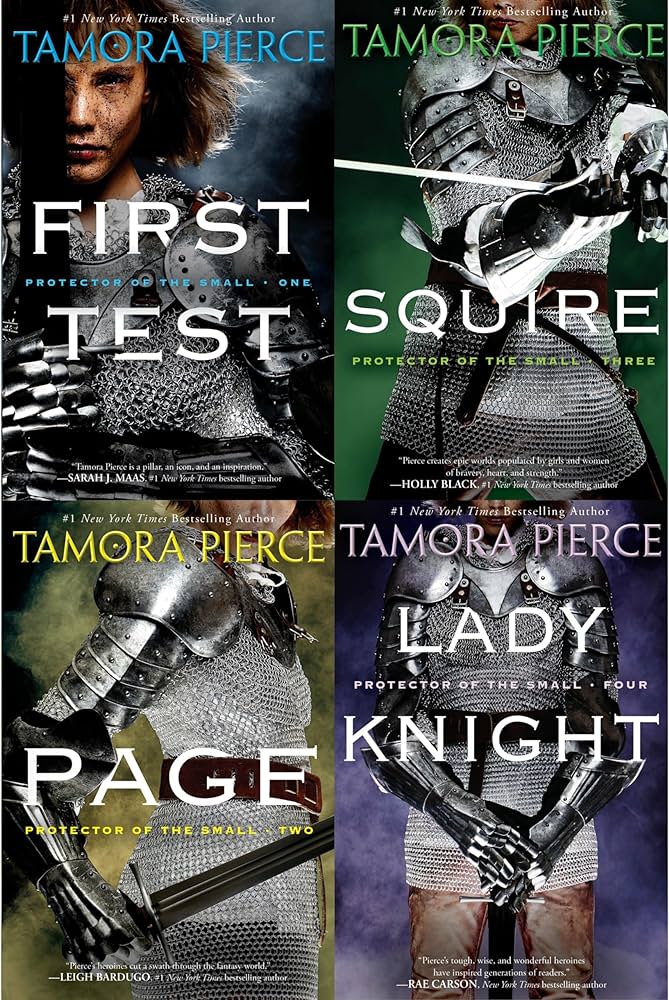
Protector of the Small Series Overview

Protector of the Small by Tamora Pierce


Spoilers for Protector of the Small and all preceding books in the Tortall timeline. You have been warned. This also isn't written in any particular order this time, just as thoughts came to me.

I have always loved Protector of the Small. I was first recommended it by my Junior High Librarian, Mrs. O. Protector of the Small was actually my introduction to the world of Tortall and Tamora Pierce's work. It's stuck with me all these years and even though I just finished it, I can say I'm looking forward to reading it again in the future.

This time around, I may have found the teenage romances a bit on the annoying side. You might have noticed that in my reviews, assuming you read them. I'm pretty sure they were just kind of a side note before this read but... yeah. Much shrugging. Not a fan of the romance. Apparently Kel isn't really, either. I found out during my reread that Tamora Pierce has said that Kel is a "aromantic asexual," which kind of tracks... though I'm not entirely sure about the "aromantic" part. She seemed romantic enough to me. But, again, I dunno. I've got the asexual part down, but sex isn't off the table for me and I do love my boyfriend so... *throws up hands in defeat.*

Having read the series before, I knew all the stuff surrounding Joren. I had forgotten that he died and actually confused his ending with the ending of one of Alanna's adversaries. But yeah, Joren's a disgusting misogynist and I hate him from the word "go." That said, I do feel like Kel getting the treatment she did from other misogynists was fairly realistic. I feel like it was necessary in that this is essentially a book for adolescent girls and it sort of prepares them for what it's like in the real world. Kel faces down men who don't believe she's good enough to be in their field in a quasi-medieval world in the same we we're still having to do in 2024. Seriously, this stuff still happens. Kel's a good role model in some ways in which to deal with that nonsense. Not the best, but Kel never claims to be perfect.

I didn't find Blayce all that interesting, either. Like yes, what he did to the children to make his mechs was gross and needed to be dealt with but... Blayce himself was just boring. The entire point of the end of the story was how Kel manages to rally people to her side and not really the defeat of Blayce. It is the culmination of the training that Raoul decided she needed. Kel is definitely a commander, of commoners, nobles, animals, etc. She just has the ability to do the direct commanding and trust the people she's delegated to. It's great.

I feel like the griffin was added in to add more fantasy to this otherwise non-fantastical story. Like yes, Kel's animals are all super smart and act in ways normal animals wouldn't. However, even with the return of the Immortals, Kel doesn't really interact with any outside of the centaurs in the Royal Forest and the griffin. The griffin isn't even really that fantastical, outside of his ability to melt cages and fly. He essentially serves as a surrogate child Kel isn't even supposed to get too attached to.. and an abusive one at that.

I like Lord Wyldon's turnaround from beginning to end. I do think he was super harsh in the beginning (see my First Test review), like, super harsh, with an unrealistic view of women. I feel like he came around slowly, but steadily. The fact that he honestly though Kel wasn't going to finish her training after she'd done most of it just because she got kidnapped or whatever it was made me want to slap him... but the fact that he came around to her enough that he realized he was stupid for not giving her permission to go after her people in the end... I also think was honestly a little unrealistic to just let go with little remarking, but it fits with Kel's overall story. I think Owen softened Lord Wyldon some more once he became Wyldon's squire. That infectious attitude toward things could not have helped but rub off at least a little, even if it was wartime.

It struck me on this read-through that these are largely stories about nobles and not the commoners of Tortall. Kel is seen as extremely odd for caring about the commoners, actually. Raoul and Wyldon think she’s absolutely nuts for going to rescue Lalasa. Merric thinks she's nuts for going after the people of Haven. It’s really hammered home how weird it is for the noble of Tortall to care about commoners. I really like that about Kel. She’s like “I’m becoming a knight for all the people, not just the nobles.” It’s progressive of her for her circumstances. It's definitely not a perfect representation, but it's better than a noble just caring about other nobles.

I feel like Protector of the Small is a nice middle ground between the sparse descriptions of Song of the Lioness and the overly descriptive Beka Cooper series. It's by no means perfect, but I feel like I could inhabit Kel's world. There's enough description for me to imagine what things actually look like and enough left to my imagination to fill in the rest.

Anyway, I love Protector of the Small. I think the first half of the quartet is better than the second, but the quality doesn't drop off drastically. I think it's a good series for the adolescent market it's aimed at, but it's also definitely readable as an adult. It doesn't talk down, which is awesome.

Wednesday, January 3, 2024

The Immortals Series Overview

The Immortals by Tamora Pierce

This post will contain spoilers for Wild Magic, Wolf-Speaker, Emperor Mage, and The Realms of the Gods. There will also probably be spoilers for any books earlier or later in the Tortall chronology.

So, I have a little confession to make: I really don't think I actually read The Immortals before. But I also kind of remember at least listening to at least one of the books on a long and trauma-blocked car trip so... yeah. This was an interesting experience, especially as there were little details about The Immortals that I know based on reading Protector of the Small and Daughter of the Lioness... like the existence of Darkings, for example. But yeah, if I read/listened to The Immortals before, I have zero memory of it. So that's fun.

All that said... I feel like The Immortals hangs together a lot better as a series than Song of the Lioness did. There were time-skips and bits of things that happened between the books, but it feels like a much more cohesive whole. Daine's journey from orphaned wild-child to a formidable mage in her own right was pretty smooth and we got to learn how her powers worked along with her. I like knowing the how of magic systems and we definitely got the how.

As I'm thinking back on the series now, Wild Magic mostly fades into the background when thinking of the story as a whole. Daine got accepted into the upper eschelons of Tortallan court? (I'm really not sure what to call it. Jonothan and Thayet's inner circle? Dunno, it's weird) pretty quickly. It was honestly blind luck that landed her there. Not that I can picture her in any other part of Tortall, but yeah... that was hella convenient.

The introduction of Numair was interesting. He fit right in with Alanna, Jonothan, and the rest so quickly I could almost forget he wasn't in Song of the Lioness. I don't really know how well his origin in the currently still-being-written Numair Chronicles is going to fit in, but that's not really a discussion for right now...

It was nice seeing Alanna and Jon again, even if it's from an entirely different perspective. Jon seems to have settled nicely into his role as King. Thayet clearly had a steadying influence on him. Alanna is ever Alanna. It was interesting to see her interact with her kids for the brief amount of time we got. My main experience in that arena is the Daughter of the Lioness duology, where that relationship is strained... but again, this is supposed to be an Immortals Overview.

I think Wolf-Speaker was probably the weakest of the quartet. It did introduce Tkaa and the Immortals who might want to stay peacefully in Tortall as well as cementing Ozorne as the overall Big Bad. I didn't really enjoy it, though Daine's growing abilities were fun to experience with her.

Emperor Mage actually introduced us to Ozorne and politics, though the politics weren't really that strong in Daine's case. She had more to contend with, what with The Graveyard Hag looming in the background. I liked seeing what a more active goddess was capable of. A lot of what actually happens in Emperor Mage happens in the background while Daine's running around with Prince Kaddar.

Finally, The Realms of the Gods. Basically a camping book... without the grueling camping or active warfare that's going on at the same time. We do get a big ol' battle at the end, but most of the book is Daine and Numair traveling mostly unimpeded through the Realms of the gods. It was kind of fun, once they actually landed places... like the Dragonlands. Dragons are always fun and getting independent ones is even more fun. Alas, this was for a brief moment before the last battle, where Ozorne is finally defeated.

I mostly did not feel like Ozorne was much of a threat in either of the books where he actually appears. I mean, sure, he is ultimately the channel for the Goddess of Chaos, but he doesn't actually do much. As Daine rightly points out to him. He schemes behind the scenes and ultimately brings his own downfall upon himself.

Also, The Immortals feels like a bad title for this quartet. There are Immortals in the books and this is where they ostensibly return to Tortall but... it's not really about them. It's about Daine and Daine's journey to at least find the true extent of her powers. Also, a good chunk of the "Immortals" aren't actually immortal so... yeah. Not a great name.

I did enjoy reading The Immortals and hopefully it'll stick itself in my brain this time. I don't really have a whole lot to say about the series as a whole. For all it's hanging together well, it was also very much four different stories about the same person in slightly different parts of her life. It's not bad, just... not very thought provoking, as it were.

Editing Me: I just realized I did not mention Kitten. Like, at all, pretty much ever in any of my reviews for this series or this Overview. Kitten is awesome. I love me a little dragon. It's like having a scaled cat, only... ya know, not as awesome, because cats. Kitten is adorable and magical and I love her.

Tuesday, November 14, 2023

Song of the Lioness Series Overview

Song of the Lioness by Tamora Pierce

Contains spoilers for: Alanna: The First Adventure, In the Hand of the Goddess, The Woman Who Rides Like a Man, and Lioness Rampant, possibly other Tortall books previous and later in the chronology

Boy, does Song of the Lioness not want to stick around in my brain. I mentioned in my Lioness Rampant review that I had read that book at least three times and I am basically rediscovering it each time. I find that's largely true of the rest of the series as well. It's not that I didn't really enjoy the series or that is a bad series. I'm really not sure what it is. Maybe the Alanna in my brain is just as restless as the one in the books and she just drags her story out with her when she leaves my head. We may never know.

I did have Alanna in my head, as well as Kel from Protector of the Small, when I was reading the Beka Cooper series. Apparently in the years between Beka and Alanna, female knights just fell so completely out of fashion that they weren't even though of as a thing anymore. I guess this is a little justified given Beka encounters that religious sect of "The Gentle Mother" that I hated. Guess their doctrine spread and we just didn't get anymore female knights after that. That Alanna didn't even think she could try for her shield as herself rather than "Alan" says so much... though it is definitely unclear as to whether or not girls trying for their shields was outlawed or just... ya know, died out eventually due to societal pressure. I'm pretty sure it was just societal pressure because Kel encounters some of the same issues but no one, in the government at least, tries to stop her from earning her shield.

A lot of things about Alanna's world are very male-centric, even outside of Tortall. Thayet couldn't inherit her father's kingdom because she was a girl. Kara and Kourrem were outcast because of their magic before Alanna came along - this may have just been Akhnan ibn Nazzir being the backward jerk that he was, but... the other shamans appear to be male so... not real sure on that one. It's not super clear what's done with girls with The Gift in Bazhir culture. Apparently women can inherit land in Tortall, but not necessarily the titles that come along with it, unless you're Alanna apparently. I get that all of this has to do with both our own history and the landscape Tamora Pierce was writing in, it's just a little interesting to look at. Or at least take note of, I guess. I kind of feel like this is an instance of trying to make this world seem pretty similar to our own instead of going "Oh hey, let's just make gender equality a thing in these societies because we can." Many shrugs.

I've kind of been mentioning and also skirting around Pierce's writing style in these books. I was so annoyed with Beka's blow-by-blow of her journeys that Song of the Lioness was a breath of fresh air but also kind of odd, to me. Pierce does a lot of telling and not showing, but also doesn't describe things in a lot of detail. A lot of Song of the Lioness does rely on the reader to imagine the settings and clothing and all that. Great swathes of time are just skipped over here, where they later won't be in other books. The characterization is also pretty sparse. We get a character description and then some instances of dialogue and actions from characters, but not enough that I'd be able to tell you "Oh, so-and-so definitely wouldn't do that" at any given moment because it's just not real clear. This does make sense as it's Pierce's first novel series and was originally a single novel before she chopped it up... a thing I did not know until reading the 2014 afterwords included in my copies. It's definitely not a bad thing as Pierce's writing is engaging in other ways, but it was definitely something I noticed. Might be part of why I have such a hard time keeping Song of the Lioness in my head.

I honestly feel like Alanna herself is pretty steady as a character throughout the series. She does grow up, but the changes are more subtle than in-your-face. Jonathan is actually the one who has the most in-your-face growth and that's mostly because he was an ass in The Woman Who Rides Like a Man... but I ranted a bit about that in that review so I won't do it here. Alanna is very goal-driven, but blossoms into a whole person when she's allowed to just wallow in parts of herself she'd neglected through her quest of her shield.

Although Alanna was written in the 1970s, I feel like she's a pretty modern character. Like modern to now, even if she did and does have to deal with that medieval male-centric nonsense. Alanna herself feels very modern. She doesn't take crap from people and has the freedom to do as she likes. I know part of that is that she's a knight and a noble on top of that, but... yeah. She just doesn't feel stuck in the societal expectations of what a woman of that relative time period "should" be.

Not that the Tortall universe should be taken as historical record of anything given that it is fantasy and does not take place in our world, but Tortall did ruin my perception of how the Knight system actually worked. I was forever ruined by Tortall's system for training Knights. It definitely did not work like that in real life, but it's a semi-neat fantasy system. Reminds me of boarding schools... which I also have very little actual experience with. Actual knights were granted knighthoods basically as a reward for service and were considered lower nobility. So, like, Jon would not have been a knight because he was the prince. Actual formal training like we see in Tortall wasn't exactly a thing, and, of course, there wasn't a magical Ordeal that made sure you could handle becoming a knight. The Wikipedia article is fascinating and goes into much more depth than I'm even going to try for here.

I really do enjoy Song of the Lioness while I'm reading it, even if I can't really remember a lot of details after the fact. The first two books are fairly quick in their progression, getting Alanna from Page to Knight. The second two are a bit more fleshed out, actually taking some time to explore Alanna's life in a slightly more day-to-day fashion without actually ending up doing exactly that. Song of the Lioness is definitely a much better introduction to Tortall than the Beka Cooper series, in my opinion. I did originally enter Tortall through Alanna and Tortall remains one of my favorite fantasy lands to visit.

Friday, October 6, 2023

Mercy Thompson Series Overview

Mercy Thompson by Patricia Briggs


This Post Contains Spoilers For The Entirety Of The Mercy Thompson Series Up Through Soul Taken. You Have Been Warned.

I've started writing this thing just as I'm beginning to read Soul Taken, partially because I wanted to get it started and partially because that little muse in the back of my brain is prodding me with thoughts. So here we go.

Mercy Thompson is largely a series centered on community. It doesn't precisely start out that way, what with Mercy being a self-professed loner, but it definitely falls into that category was the story progresses. I find this sort of thing seems to happen when there is one protagonist and they find themselves becoming essentially the center of their supernatural community for one reason or another. Mercy started with the Columbia Basin Wolf Pack and jumped right into the entire Tri-Cities Area. At the same time, each piece of the community definitely has their own flavor and they don't actually mix very much, or as much as I might have made it seem in this paragraph. I was originally just pulled in my the werewolves and vampires, but the rich Fae mythology and a bit of the witch stuff was a nice addition that helps make Mercy's world feel lived in. Not gonna lie, the line-up of people who went to Italy to "save Mercy" from Bonarata in Silence Fallen made me tear up a little. This community is also still in its fledgling stages as of Soul Taken, with no one really trusting each other very far, but Mercy spends the entire book referring to the vampires as "our vampires" and Larry the Goblin King wants to be friends so... baby steps.

I find it really gratifying that Mercy and Adam have a mostly stable and fairly healthy relationship. That sort of thing is definitely not normal for these sorts of series. Usually, there's a lot of relationship drama between the main character and his/her beau to distract from the main story. It's actually quite nice to not have to worry about that happening through most of the series, Smoke Bitten notwithstanding. Adam's Ex, Christy, really makes me want to throw things so Mercy and I agree on that, at least.

I also quite like that Mercy is definitely more human than the people she runs around with and it's actually shown. No super-human healing for Mercy... except that one time when Coyote saved her life. But otherwise, Mercy actually spends a lot of time in hospitals, healing from various injuries that would definitely be sustained by a largely non-supernatural character. She also actually gets exhausted and actually shows signs of shock when that happens, so, yeah. Gimme some realism with my fantasy, please.

It also makes me immensely happy that Mercy is first and foremost a mechanic. She doesn't have any policing background and doesn't even get super involved with the policing aspect of the "Protectors of the Tri-Cities" thing she imposed on the pack. In fact, it's very rare that she's actually involved in the policing aspect at all. Yes, Mercy does do a lot of problem-solving, but that's usually while she's fixing a car. This all makes a nice change from, say, Anita Blake or Rachel Morgan or any of the other urban-fantasy protagonists I've read. That Mercy is a mechanic and almost stubbornly stays a mechanic throughout the series makes me very happy, even if she does spend a lot of time closing her shop due to supernatural reasons.

My favorite wolves are definitely Ben and Honey. Ben reminds me a lot of Spike from Buffy. Both problematic faves, I do realize. Honey, though, is definitely a lot less problematic. I felt very much for her loss, but feel that she's rallied well afterward. That she's ended up 4th in pack ranking the last time that was mentioned (Sherwood's recent discovery notwithstanding) makes me very happy. I definitely still love Warren and Kyle, but they've dropped behind Ben and Honey so... yeah. There's also not been a whole lot with Warren and Kyle after the first few books, which makes me a little sad, but... le sigh. Just gotta deal with it.

I guess now is as good a time as any to discuss my biggest pet-peeve in all of supernatural media: How Werewolves Work as Opposed to Actual Wolves. So, the way werewolves work was originally pulled from research on captive wolves and later David Mech's book in 1970. You have an Alpha wolf/mated pair who rule over the rest of the wolves based on their dominance and the pecking order goes by who's more dominant or less dominant. Patricia Briggs' werewolves definitely follow these guidelines as to how the pack works and even has submissive wolves playing quite a big role in keeping the dominant wolves from going nuts on each other at any given moment. This is all well and good for werewolves, but it's not actually how real wolf packs work and so it bothers me a lot. I mostly shove these thoughts into the back of my brain while I'm reading these days, but it's still a thing that bugs me. Of course, werewolves are also influenced by their human sides, Patricia Briggs' work actually mentions this and pretty much cites it as the reason her werewolves have females taking their rank from either their husbands or just being lowest because female. And look, it works well enough in fiction, so you can have certain werewolves get all tetchy about stuff, but... I hate it and want it to stop. Most likely won't anytime soon, so I just have to deal with it.

I feel like the Fae in the Mercy Series are a lot more "true to life" than other series make them out to be. It's neat how their various mythologies are woven in with more modern stuff. I particularly love Baba Yaga and was reasonably pleased with Rumpelstiltskin's portrayal. Mostly we get Zee being grumpy and Tad being around. Uncle Mike and Beauclaire are also notable... or would be in the absence, I guess. I like that they're so precise with their wording and definitely more dangerous than the humans want to believe. I'm not so sure about Underhill, though. Like, really not sure. I think the issue is just not being able to "get a read" on her. She's too tricksy and old and just... very Fae like, even to the Fae. I really don't like how she's got her claws in Aiden... but that's an ongoing issue that I don't think is going to be resolved anytime soon.

Patricia Briggs' vampires have interesting mechanics. I'm pleased that they take a while to make, essentially, otherwise I feel like they'd be overrunning the world by "breeding" like rabbits. It is also quite interesting that we end up dealing with pretty old vampires, for the most part. Bonarta, Marsilia, Stefan, and Wulfe are all centuries old. Probably the youngest "major" vampire we saw was Frost, who was only a few decades, if I'm remembering correctly. I also kind of like the "sheep" or "flock" aspect of their feeding pool. Makes a lot more sense if you want to stay in the shadows to have a dedicated pool of people to feed from rather than leaving dead bodies in your wake all the time. Wulfe jumped to the fore of the Mercy vampires with his stalking of Mercy and the whole thing in Soul Taken. He's... interesting definitely, but also very unique. He's the only tri-species vampire I've ever come across in my reading, so that's neat. Like Mercy, I'm really not sure how to feel about him.

I want to give a special shout-out to the Mercy cover artist: Dan dos Santos. I love his work and feel like it truly captures Mercy. Also, I never do cover artist shout-outs and I kind of stole the cover-pic collage from his website, so yeah. You can take a peek at his website: HERE.

Wednesday, July 26, 2023

Family Spies Series Overview

Family Spies by Mercedes Lackey


This Post Will Contain Spoilers For Family Spies, The Herald Spy, Collegium Cronicles, ETC, Through The Back Catalogue of Valdemar Books. Also A Slight Spoiler For Heralds of Valdemar.

You Have Been Warned.

Once Upon A Time, Herald Mage Vanyel took it upon himself to create a magical early warning system consisting of air spirits known as vrondi. The vrondi were to watch for any signs of magic within Valdemar and report back to the Herald Mages so the Herald Mages could take care of the Mage they saw. However, Herald Mage Vanyel did not forsee that he would be that last of the Herald Mages for nigh on 300-something years. The vrondi were left with no one to report back to and instead simply watch the Mages, if they cross into Valdemar. Somehow, Herald Mage Vanyel's clever spell also caused Mage Gifts to be suppressed within Valdemar until such time as Herald Mage Elspeth's Mage Gift manifested... I guess. The spell somehow also made it weirdly hard for anyone in Valdemar to talk or think about magic at all, unless it's Mind-Magic... apparently. Oh, and the vrondi know when and where Valdemar's borders are at all times, even after expansion. How is anyone's guess. The vrondi don't bother Mages outside of Valdemar, either. Also, Herald Mage Vanyel didn't tell anyone about his vrondi warning system. But the focus stone he used to set the vrondi spell and the Herald Web knows about it, but no one can remember the stone even exists... except Herald Mags... it's all very complicated. I've said it before and I'll say it again: this vrondi thing is stupid.

Meanwhile, Mercedes Lackey decided to write Family Spies; a series in which each of Herald Mags and Herald Amily's children go outside Valdemar and have one magical adventure each. Perry's adventure took place in the Pelagirs, which still has magic and is just very odd to begin with. Abi's took place in a bit of unincorporated land Valdemar was looking to annex at the request of its inhabitants. And Tory's was mostly in Karse and a couple of the lands surrounding it. Honestly, I found these stories much more fun and interesting than I did the entire The Herald Spy and Collegum Chronicles series. No court intrigue, no annoying characters I didn't care about, very little actual spying... not that the spy training didn't come in handy, mind you, it just wasn't super prevalent. I think Perry got the most use out of his spy training, going deep undercover like he did. But yeah, none of these adventures was even able to take place within Valdemar because of the overall magical nature of them. Not exactly a bad thing, but... ya know... really obvious.

I did very much enjoy getting a look at the other creatures that inhabit the lands surrounding Valdemar. The dyheli finally got more than a passing mention and their own magical refuge by the end of The Hills Have Spies. We got a kyree encounter in the form of the Scooby Doo dupe Ryu and Larral. They're alright, I guess. Oh, and that Scooby Doo thing is better explained in a short story "Moving Targets"... Herald Arville is basically Shaggy and that big ol' wagon Mags and Perry use was the Mystery Machine. It was a whole thing. The afrinn were a fun addition, though I would very much like to know what the big difference between afrinn and vrondi are... probably the amount of power or something. Also, afrinn reminded me a lot of djinn, but that might just be me. I didn't particularly enjoy the Karsite demons, but I'm glad we finally got a better description of them than just "demons." That's such a catchall term these days.

I think my favorite characters were Abi, Jicks, and Sira. Abi's definitely my favorite of the Mags/Amily Clan. She's sure of herself and fairly unruffled when it comes to most everything. Also nice to get that Ace representation. Jicks was a fun lesbian mercenary, though that's pretty much her whole personality so... not real deep, but fun. Sira's a badass with a heart of gold. I like how resourceful she is and how attached she got to her afrinn friends. Her parts of Spy, Spy Again were a welcome break in between Tory's narration of their travels.

I honestly don't have much to say about Family Spies as a whole. Each story was self-contained, sharing characters but not much else. I liked Abi the best, out of the three kids, though her story was honestly the weakest. Perry was alright and Tory was mostly just dragged along on Prince Kee's adventure. I definitely had more fun with Family Spies than The Herald Spy.

Monday, June 26, 2023

The Herald Spy Series Overview

The Herald Spy by Mercedes Lackey


This Post Will Contain Spoilers For The Herald Spy, Collegium Chronicles, and Any Valdemar Series Previous to These on the Timeline. You Have Been Warned.

Alrighty, The Herald Spy as a series. It's been a few days since I actually finished Closer to the Chest and I have to say, this series has not left a lasting impression on my brain. The Herald Spy picks up right where Collegium Chronicles left off, and I mean right where it left off. Mags has finished his year of Circuit, or however long his Circuit lasted anyway, and is on the road back to Haven. Lena and Bear have been rather unceremoniously dropped off at some Baron's household where Lena is the official Bard in Residence or whatever. We're left to follow Mags and Amily through the rest of the series.

The first really big thing that happens is Nikolas' death and Amily's ascendance to King's Own. This was only slightly shocking to me as I have spent a little amount of time perusing the Valdemar Wiki and found Amily's name on the list of Heralds beside Rolan's name and designation as King's Own. I was actually more shocked by how fast I perceived Rolan as giving up on Nikolas, especially as Emery (Nikolas' new Companion) was right there in the moment to save his life. Of course this sends my brain spiraling down the rabbit hole of potential futures where Valdemar ends up with equivalents to our life-saving technology and having Heralds end up dying for longer than Nikolas did only to end up surviving thanks to an equivalent of a defibrillator... but that's really neither here nor there, just where by mind went during this exchange of Companions.

So anyway, Amily's now King's Own and develops a semi-useful Mind-Gift of looking through the eyes of animals. Amily and Mags start building up their own network of spies throughout Haven, including such notables as Lady Dia, Lord Jorthun, Mindy, Mag's little band of kiddos, Flora, etc. Meantime, there's a Romeo and Juliet plot happening under their noses that's honestly mostly boring and exposes the societal flaw of Valdemar of High Born women mostly being marriage fodder despite there being other avenues for them to pursue if they so chose... I don't know, I was sick of it pretty quickly. Never been a fan of reading through that part of our history and having it shoved in my face all the while having Amily going "oh, it really sucks for them and I wish they had more opportunities outside of that" without actually doing much aside from handing Violetta some books... just much blah.

Honestly, a lot of The Herald Spy was just blah. There's a lot of Mags running around through Haven during which we get descriptors of Haven, over and over, really. I'm pretty cure I skimmed most of it, to be honest. Haven's just not that interesting of a city and there's not a lot that actually goes on there.

Closer to the Heart sees Mags and Amily finally married, eloped before the state wedding that takes the entire book to plan... which they have very little involvement in. Honestly, very relatable. My boyfriend and I often discuss how that's essentially how we'd like to be married if we choose to get married some day. Someone else can plan the party and we'll attend. Amily and Mags do this for slightly more practical reasons: they always seem to be getting into trouble that would keep pushing their wedding further and further down the line... which this plot does a little. Closer to the Heart actually sees Mags doing some spying that actually matters in terms of keeping Valdemar out of war.

Getting out of Haven was nice, however, we got another deep-dive into Mags' personal trauma: His time at the mine. The mines he visits are so vastly different from the mine he grew up in, it triggers his resentment toward Cole Pieters. Again, as it was revisited in every single Collegium Chronicles book, it really feels stale here. Not out of place, just stale. But the teensy bit of information Mags uncovers here kind of blows the lid off the whole plot, which ends up saving Valdemar from war.

Here's also where we get the understanding that no one outside Haven really understands how Valdemar and Companions and things actually work. General Thallan in Closer to the Heart just straight up doesn't think about the Mind-Magic among Heralds in his plan to take over Valdemar. The priests of the disgusting Church of Sethor think they can just murder Amily to replace her with Nikolas as King's Own... I mean, they probably would have been happy with another man being Chosen, but they also don't know how all that works, obviously. Every time this stuff was revealed, I just rolled my eyes. No one with eyes on the Valdemar throne really does their research into how Heralds and Companions actually work. General Thallan came really close, honestly, but, again, Mind-Magic is a thing he apparently knows about enough to drug Mags and Amily but not something he thinks about in terms of a coup. Also, just knowing there are more Valdemar books after this had the stakes fairly low in my head, so there's that.

Closer to the Heart is also where Mags picks up a artisan Tuck and -- essentially his translator -- Linden as part of his spy network. Tuck makes all the useful "gadgets" Mags and Amily eventually use to escape from General Thallan. Linden and Tuck were fun additions to the cast and I honestly wish there'd been more of them through the series. But no, we only get them in Closer to the Heart.

Aaaand finally we come to Closer to the Chest... it was boring. Skip it. Save yourself the annoyance and eye-rolling at all the woman-hating and apparent impotence of the Valdemaran government. It honestly annoys me at how long it took Mags to get properly into the Church of Sethor in order for the end to happen. The ending, by the way, I more or less saw coming from the moment the head priest snubbed Amily during his introduction. It was so bloody obvious who was ultimately involved... just... ugh. "There is no one true way" really needs that amendment "Except these particular things that are part of no-one's way." I ranted a bit about this in my review of Closer to the Chest, so you can go read that if you'd like to read more of my annoyance.

I honestly didn't have as much fun reading The Herald Spy as I did Collegium Chronicles. The Herald Spy just isn't as engaging of a trilogy and ended up leaving me with a sour taste in my mouth.

Saturday, May 27, 2023

Collegium Chronicles Series Overview

 Collegium Chonicles by Mercedes Lackey

This post will contain spoilers for Collegium Chronicles and previous Valdemar series on the timeline. You have been warned.

I had read someone's review of Foundation where someone said Mercedes Lackey was rewriting Harry Potter due to similarities between Mags and Harry and kind of the plot. (This was after I'd read Foundation) Though there are a few similarities in Foundation, Collegium Chronicles is definitely not Harry Potter rewritten for Valdemar. To begin with, the story takes a turn for the very dark very quickly. Mags is by no means a Harry type character. Mags is way more clever and thoughtful and actually athletic than Harry ever was. There is also Kirball, which I felt was much more fun to read than Quidditch and was definitely different from Quidditch. For one thing, all the players are actually engaged with the game at all times rather than having a Seeker off to one side trying to find the Snitch. That's pretty much where the Harry Potter similarities end. The additional characters don't even have one-to-one analogues once you get past Bear and Lena being male and female like Ron and Hermione are. Would I recommend Collegium Chronicles to Harry Potter fans? Yes, depending on the age of the Harry Potter fan. Like I said, Collegium Chronicles gets real dark, real fast.

I really feel like Collegium Chronicles is really an extended prequel to Herald Spy (which I have not read yet). There's not a lot that goes on that doesn't add to Mags' ongoing accumulation of skills. Even Mags' small circuit run had very little in the way of actual Herald training. We actually don't get a lot of Herald training for Mags. He's mostly either catching up in academic classes or running around for Herald Nikolas doing the spy training thing... and of course the kidnapping situation in Redoubt. Mags will clearly not be a traditional Herald and so getting too into the weeds about traditional Herald training would have been a little silly. Add to all this the fact that technically, due to how new the Collegium is, Mags is technically getting a more "traditional" round of training. He's taken under the wing of a Herald as an apprentice rather than being stuck in a classroom all the time.

Collegium Chronicles has a large focus on the lasting trauma that Mags suffered throughout his early life. There's not a book that goes by where Mags doesn't look back on dwell some on his life in the mines. I honestly found this a little annoying, but I realize through my own dealings with trauma (nowhere near the level Mags or others have gone through)  that trauma does color your life in ways you might not think about. It does make sense that Mags would keep coming back to it over and over again. One thing about this I found lacking though, was the hammering down of how old Mags is actually supposed to be at any given point. The timeline of Collegium Chronicles seems to take place over about three to four years, but I'm not even sure on that count. I assume by the end that Mags would be about 18, maybe? It's really hard to pin down, especially because of the pseudo-renaissance-y society that Valdemar has at this point... after all, Lena and Bear get into a huge kerfuffle about getting married when they did due in part to their age. I feel like the age thing is important here, because Mags' whole life before becoming a Herald Trainee was the mine and it would be nice to know how long that actually was.

All of the secondary characters in the Collegium Chronicles are very secondary. We get a little bit more of Bear and Lena during Foundation, but after that, they're just sort of floating in the background. Given how much stress was put on Master Sorenson during Foundation, I thought that group of high-born people was going to have more of an impact on Mags' life... they did not. We barely get any more Lydia after that and the focus definitely shifts toward Amily. Amily's characterization is mostly done through stressing how she's her father's daughter and really more into the research side of things. She is shown to be adaptable after the surgery to fix her leg and kind of becoming Bear's assistant during Bastion. Nikolas actually ends up with more characterization than anyone else. He is at the forefront of Mags' training and Mags seems to spend more time around Nikolas than pretty much anyone else besides Dallen. Dallen himself is actually my second favorite Companion after Yfandes. He's just a generally fun-loving Companion who has zero problems throwing shade when he feels it necessary.

I would be remiss if I didn't at least mention the Kirball team. Gennie and Jeffers were probably the most active in terms of the narrative. They're also literally the only two I can actually remember off the top of my head. I liked Gennie a lot. She was a solid team captain and has a good head on her shoulders. I'm glad the Kirball team came together around Mags a few times, trying to shield him from the whole "foreigner" issue during Intrigues and from being overwhelmed when he returned from his kidnapping at the beginning of Bastion.

Other characters of note are of course Lita, Jakyr, Franse, Reaylis, and Bey. Lita and Jakyr serve as the adults in charge of Mags' circuit run. That's really where we get to know Jakyr even though he was the Herald that helped Dallen get Mags in Foundation. He, like Lita, are kind of in the background the entire time, but like, way in the background. I really enjoyed Franse and Reaylis. I gushed over Reaylis in my Redoubt review so I won't go back into that here. Bey was an interesting addition at the end of Bastion. I think he largely served the purpose of getting Mags some assassin training without actually having to train Mags to be an assassin. I feel like Bey's assassin skills would be super applicable to spying. I mean, clearly, as Bey spied on Mags and friends the entire time they were at the Bastion. I do wonder how much of Bey's spying got him in turn spied on by the vrondi... he did not seem bothered, so... I don't know. That whole situation was just odd.

I also noticed a few things about magic in Valdemar that were interesting, to say the least. Reading through these books in chronological order has me questioning how quickly Valdemar seems to have forgotten things over the years. It's also a tad weird, because (according to the Valdemar Wiki) it's only been about 50-some odd years since Vanyel died. It just seemed really weird to me that things like Mages and the magic they wielded would have faded into obscurity so quickly. The Heralds of Mags' time rely solely on whatever mind-magic they might have and don't seem to have any curiosity as to, for instance, Vanyel's magic would have worked. I know that all the Herald Mages were basically killed off with Vanyel, but I find it really odd that Valdemar has absolutely no mages anymore, at least not until Elspeth in the Heralds of Valdemar series. I probably shouldn't be surprised that the information has been lost and turned into heresay so quickly, but I am and it's sad. I guess the combination of Stefan and the Companions really did a number on the information about magic being more common place. The fact that the Companions are semi-actively discouraging their chosen from even trying to delve into magic or the potential of the Mage Gift probably helped all this along. We see Dallen just be like "it doesn't matter" when Bey unwittingly gives a bit of this kind of info to Mags... and of course no one knows what's going on with the Magic Stone focus thing-y holding the Herald Web together. Companions are a bit sus, man; I do not approve.

Overall I really do feel like Collegium Chronicles is a prequel to Herald Spy. Mags is getting his training and managing to set up both support and information networks. There isn't really a strict progression of one year to the next, which does make sense given how Companions end up deciding when to choose their partners. I'm not sure how I feel about the ending to Collegium Chronicles. I feel like it'll just bleed into Herald Spy, but I guess I'll have to start that and see.

Tuesday, April 18, 2023

Midnight's Daughter Series Overview

Midnight's Daughter/Dorina Basarab by Karen Chance

This post will contain spoilers for the entire series and the Cassandra Palmer series. You have been warned.

So, the Midnight's Daughter/Dorina Basarab series. I found it to be much tighter in terms of plot than its sister Cassandra Palmer series. The characters were much more vivid and well rounded. It actually felt as though Dory's story took place during war times. Dory was much more informed and actually engaged with her story than I felt Cassie was. Even her cadre of side characters had stakes. Honestly, if I were to recommend one series over the other, I'd recommend Midnight's Daughter/Dorina Basarab. I will now try to focus on Midnight's Daughter/Dorina Basarab and not compare it to the Cassandra Palmer series further... they really are too different to compare very much anyway.

I do have a numbers question that’s been niggling at me for at least the last two Dory books. How many vampires are there? How many fey end up on Earth, like population-wise? How many Silver Circle mages are there? The Cassie books make it sound absolutely dire for them to be dying due to the whole Artemis’ spell thing, but there are enough to be running a crime scene back in the Dory books? The sheer number of supernaturals running around makes it seem like the humans should at least be aware of them, but they’re not. And like, why not, really? I mean, I also get that the various supernatural races don’t really play well together, so a coherent government might not work well, but like… I’m just confused as to how all of it works to begin with. The vampires apparently have MASSIVE numbers given the amount Dory mentions as being in Mircea’s family alone and what we see from Cassie’s bodyguard contingent. It really seems like this should be a world where the supernaturals mesh with human society rather than being utterly separate.

I believe I've ranted some about Mircea in my Cassie Palmer reviews, if not the overview, but he's gonna get his own section here. I, uh, pretty much hate Mircea. He's utterly selfish and a complete ass to those who he professes to love. He's so obsessed with his dead wife that he courts Pythias across his centuries of life to see if they'll consent to bringing her back to the present instead of her just dying. It's made worse in Cassie's case due to his a) not knowing if she was going to by Pythia in the first place; b) putting a really gross charm/curse thing on her when she's really young; c) passing off the way used to break said charm/curse to someone else; d) vampire marrying her under the influence of the charm/curse gone wrong; and e) not mentioning his ulterior motive for any of this to her until well after he'd established a relationship with her. Like, what the hell? In regards to the Midnight's Daughter/Dorina Basarab series, Mircea's big thing is about Dorina. Keeping Dorina separated from Dory well after he should have. Not even wanting to explain anything to Dorina before or after separating them. Not even wanting to talk to Dorina after discovering he hadn't quite locked her down as much as he thought he had. Oh, and 500-something years after the fact, painting Dorina as the absolute worst creature ever in order to get Dory to consent to trying to lock Dorina away again. Sir, that is your daughter, whether you like it or not. I understand locking Dorina away essentially saved both Dory and Dorina from certain death, but once they were adults, you really should have, I dunno, asked for their opinions on the matter. I also get that Dorina doesn't seem that angry with him about it, but I'll stay angry on her behalf. While he was locking Dorina away, Mircea also wiped Dory’s memory of her life, ostensibly to protect her, but it’s not until Time’s Fool where we find out just how much of her memory he wiped. She doesn’t even recognize him when he hires her to take care of some revenants. What the hell, Mircea? To make matters worse in the present, Mircea goes swanning off during a WAR after his not-as-dead-as-previously-thought wife... 500-something years after her supposed death. Yeah... fuck Mircea.

I really enjoy how Fae/Fey play a role in Midnight's Daughter/Dorina Basarab. Mostly the so-called "Dark Fey" in the form of the trolls who live with Dory and Claire. Claire herself with her dragon-half and cadre of "Light Fey" bodyguards is a nice grounding influence. Not sure I love the dichotomy of Claire being a vegetarian and her dragon half definitely carnivorous, but she's an otherwise great character. I love Olga to death. She's the kind of community mom that Dory seems to need around. Caedmon I could probably do without... but, ya know, gotta have those allies in this big war that's going on in the background. Olga's sons of nephews (I can't be bothered to remember or look up which they are) are alright and just kinda there for the most part.

I'm a big fan of Ray. He's mostly comic relief when he's introduced, but it turns out he's a lot more valuable to Dory and Dorina than anyone originally thought. I like how stubborn he is about protecting his vampire family. I like how he is with Dorina, not coming across as condescending or anything to a being who's basically a child. Ray's resourceful and funny and I just really enjoy his character.

I will say, Karen Chance does have a habit of introducing random characters to the series in info-dumpy kind of ways. One that really stands out is the War Mage Jacob, probably because he was kind of a big deal in Shadow's Bane. For some reason, though, this sort of thing works well in that we're meet Dory present day with some 500 years of experience under her belt. It's not as though she hasn't had time to make connections we just haven't seen.

So, after a couple days of slogging through four pages of Time's Fool, I've decided to drop the Midnight's Daughter/Dorina Basarab series. I was just really disappointed in how Karen Chance chose to go from a cliffhanger at the end of Queen's Gambit to jumping to the 1500s and completely away from the modern-day storyline. Maybe I'm just used to my series going chronologically from one event to the next, but I'm annoyed with the whole thing now. It's actually kind of sad, because I really enjoyed Queen's Gambit and was otherwise enjoying the Midnight's Daughter/Dorina Basarab series. I might look up the next Dory book when it comes out, but it's not on my priority list the way something like the Anita Blake series is. You can read more about this decision in my Time's Fool review.

Overall, the Midnight's Daughter/Dorina Basarab series is delightful. Quick-paced action and somewhat funny interludes and actual compelling mysteries serve the series well. The character work is well done, too. I definitely did not do it justice in this overview.

Monday, April 3, 2023

The Last Herald Mage Overview

The Last Herald Mage by Mercedes Lackey

There will be spoilers for the entire trilogy in this post. You have been warned.

Alright, here we go. The Last Herald Mage trilogy is kind of a hard one for me to put an overall label on. The series takes place basically over Herald-Mage Vanyel Ashkevron's lifetime but there are very few actual events from that lifetime that we get to witness. Mostly we get to witness Van's various recovery eras rather than his exploits, which I think is fair. Vanyel has got to be one of the most traumatized characters I've encountered in a while.

So when we first meet him, Vanyel is being mentally abused by his father, Withen and various siblings/foster-siblings while at the same time being physically abused by the Forst Reach's weapon's master, Jervis. All this prompts Withen to send Van off to his sister in Haven, Savil. While this stops the abuse, Van ends up pretty much shutting himself off emotionally from everyone he meets until one Tylendel Frelennye manages to get under Van's skin and break him of this destructive behavior. It's nice that Tylendel is able to do this, really, but that relationship is pretty much never healthy. Healthier than it could have been, yes, but it's not great that they become codependent.

I've never been a fan of the Van/Tylendel pairing and I really think part of that has to do with how rushed it is in Magic's Pawn. We go from Tylendel bringing Van out of his protective shell to them being absolutely inseparable (within Savil's living quarters anyway) to Tylendel's breakdown upon the death of his twin and Tylendel's death, all in pretty quick succession. We barely get to see Van and Tylendel as an actual couple and their dynamic is remarked upon as being potentially unhealthy by Savil, who then never really checks up on that afterward. She just leaves them to their own devices even when she probably shouldn't have. Aaand then Tylendel manipulates Van... so it's just always left this icky feeling behind, for me anyway.

I find the Van/Stefen romance much more palatable, reincarnation stuff aside. It really doesn't affect their relationship at all anyway, since Savil and Starwind opt not to tell them about that. I feel like Van and Stefen came at their relationship in a much healthier manner and it really feels like an actual relationship. I'm also glad Stefen stuck by Van when they went off after Van's nemesis. Van needed a more grounding influence on that trip than even Yfandes could provide... and then, ya know, help through the trauma after the bandits captured him. Thinking about Van's relationships now, actually, it's like the difference between your do-or-die teen romances as opposed to more adult ones. Just all the cringe followed by something much, much better.

And speaking of those changing relationships, Van and his parents are interesting to look at. We're made to really dislike Withen Ashkevron in Magic's Pawn but by the Magic's Price he's mostly a cuddly teddy bear. I think the progression throughout Van's life is quite realistic, even if, at times, it does seem a little rushed. I found the timeline a tad hard to keep track of between Magic's Promise and Magic's Price, to be honest, which accounts for the rushed feeling. Withen's change in attitudes are also helped along by the death of Father Leren and a retelling of Moondance's story. Treesa, on the other hand, is a bit of an odd duck to me. I like that she at least attempts to foster Van's talents and later completely accepts Yfandes. I find her clinging to youth thing more annoying than anything else, and that "courtly love" thing she does rubbed me the wrong way. Of course, not being a girly-girl myself and having absolutely no flirting game, I'm not even sure how the "courtly love" thing actually works. However, if it's coming on strong enough to freak out a traumatized child, there's an issue.

Van's other family members aren't really worth going into, but I do have to mention Van's sister, Lissa. I wish we'd gotten more Lissa. I liked Lissa.

Jervis turned out to be a much more likeable man and important character during Magic's Promise. He clearly had some time to think about how he treated Van and how he should be treating his other charges. I think it's a little odd he didn't tell Van why he wanted to spar all the time instead of just letting Van stew about it... but it turned out all right in the end.

I feel like I'd be a bit remiss in not mentioning the Tayledras pair of Moodance and Starwind k'Treva. They are instrumental in both healing and training Van after the whole Tylendel incident. They also help after the assassination attempt on Treesa. I like them, but they're also relatively flat as characters. Moondance is more fleshed out than Starwind, but mostly because of his backstory... which is told exactly the same way in both Magic's Pawn and Magic's Price, though with different intentions.

Pivoting to the plots of The Last Herald Mage: I'm pretty sure I enjoyed Magic's Promise the most. Magic's Pawn mostly just had Van along for the ride and then recovering from that ride. Magic's Price felt like there was too much for the one book. Magic's Promise, while mildly infuriating, probably had the best overall plot. The mystery around Tashir was a good one and fairly well put together. My only issue with Magic's Promise was just how long it took Van to get back to the initial crime scene. An actual investigator, he is not. It also bugged me a little how long Van spent undercover in Lineas for fairly little reward.

There's also some discussion (actually a fairly small discussion, but turned into Stefen's life's work after Van's death) in the books about how Heralds are viewed and view themselves. I find it interesting that Herald-Mages are apparently much more valued than regular Heralds... probably because I read The Heralds of Valdemar trilogy first, in which there are no Herald-Mages. So... the numbers just don't seem to make sense to me in terms of valuation. Granted, we as readers don't actually have a good idea how many Herald-Mages there were to normal Heralds, but we do know there aren't many older Herald-Mages to act as guides to the younger Herald-Mage Trainees... hence part of why Savil had three trainees at the start of Magic's Pawn. The Herald-Mages were also largely wiped out during the war with Karse to the point that it left Savil, Lissandra, Van, and Kilchas as the remaining Herald-Mages. The numbers in my head of Heralds vs Herald-Mages just don't make sense with how the general public views them... I mean, I guess it's probably more akin to, like, A-list celebrities vs the rest of Hollywood. I don't know. It's just odd to me.

I'm not really sure I have much else to say about The Last Herald Mage. I did enjoy the trilogy a lot more than I did The Mage Wars and a little less than The Founding of Valdemar. Yfandes is probably my favorite Companion.

Thursday, March 9, 2023

Cassandra Palmer Series Overview

Cassie Palmer by Karen Chance

Contains Spoilers for the Series

So, I haven't actually read this entire series. I got up to book 8 (Ride the Storm) before I decided to stop. I'd been getting frustrated with the series during the last few books and Ride the Storm had me at a stand-still. I really think the whole Pritkin storyline killed the series for me. That aside, I thought the Cassie Palmer series was fairly good to start with.

So, Cassie Palmer is this girl with clairvoyant powers who gets thrust into a job policing the timeline, known as Pythia. Her powers are basically gifted to her via the Greek and Roman god Apollo... who turns out to not be one of the good guys. Cassie has no idea how to use her new powers and basically has to figure this all out on her own. And there's vampires and stuff involved, so that's fun. Also mages and a scattering of witches, none of whom can actually help her figure out her powers. She still hasn't quite figured them out by book 8, but she does get more competent with them and I'm sure will eventually figure all of that shit out.

In addition to the "not knowing how to use her powers effectively" thing, Cassie has to deal with a really gross curse binding her to vampire Mircea Basarab and her bestie, Pritkin, getting himself cursed/dead in such a way as to, by my understanding, hurt Cassie's present. I really was having fun with this, I swear, until the second book of Pritkin needing to be saved ended with him still not being saved... and then Ride the Storm just frustrated the hell out of me.

But anyway, that gross curse binding Cassie to Mircea is called a geis. It's all explained really reasonably that the geis basically makes sure that the cursed woman (because it's usually a woman) will always end up attracted to the person (usually a dude) who set the curse until such time as a marriage is consummated, because of course that's the only way we get to have sex at the time this geis was created. Oh, and the dude that set the curse can designate someone other than himself to consummate the marriage. Add to that Pythian time-travel powers and a couple of vampires and you've got yourself a gross love triangle and and even worse main couple for the series. Yes, it gets worse. Cassie ends up "vampire married" to Mircea. Mircea, it turns out, put the curse on her so she'd be more likely to say yes to bringing his dead wife out of the timeline and into the present. So... yeah... that's great. I was so done at that point. Really seemed like Cassie was, too, but I'm not entirely sure so... yeah...

Moving on to Pritkin's whole deal... I like Pritkin as a character. He's the no-nonsense protector/magic man with a surprise dark past. And, ya know, British and blond and always wearing that big ol' leather coat. Until he gets cursed to death and then we get to go back in time and deal with pre-Pritkin Emrys/Myrridan/Merlin for entirely way too long, in my opinion. He's finally uncursed at the end of Ride the Storm in a fashion that had me wanting to throw the book across the room... Rosier literally hands him the counterspell that I, and Cassie by the way, was previously under the impression had to be counterspelled onto Pritkin by Rosier. But no, could have given him the counterspell at any time previously and skipped the hanging out with Myrridan thing. Like... yes, there's some other stuff happening being that far back in time, but the whole Pritkin plot could have been resolved by giving him the counterspell and getting out of dodge?! Just... ugh!!!

Rosier starts out as a villain and basically ends this run of the series as a formless bunch of smoke, I think. He's kind of alright once we get to know him outside of the villain context. I think mostly because, at that point, he has zero powers and is just tromping around after Cassie and Pritkin at that point. All the menace has gone out of him.

Other characters of note here are Jonas, the dude Pritkin and Cassie ended up helping get back in charge of the Mages. He's kind of fun for the first book he's in and then he just becomes useless and annoying. He basically tries to teach Cassie one Pythian trick and then buggers off to deal with Ares research... meantime keeping Cassie's court from her and giving Cassie zero information about anything. Then there's Cassanova, who is a mostly cranky vampire manager of the hotel Cassie's living in. Augustine, a part-fey mage designer who's fun to read about. At least, his designs are. Rhea, who, it turns out was Agnes and Jonas' daughter. I like her. She actually gives Cassie info Cassie needs. Agnes herself, the previous Pythia. She's around, kinda. Cassie's dead parents put in a couple of appearances. I kind of like her dad. Her mom's Artemis, the former goddess, who we learn decimated the Demon Lords previously.

The Cassie Palmer series does this thing with Greek and Roman mythologies that I think we all tend to do when initially getting into it: mixing them together like they're one in the same. While they are very similar, the Romans did co-opt the Greek mythology so there's overlap, but they're really not the same. There's also some mixing in of other mythologies -- Norse and Egyptian, if I'm remembering correctly -- that happens when Jonas is attempting to explain the gods attempts to return to Cassie. It's, uh, not entirely great. Each of these mythologies is their own thing and, while other cultures may have borrowed pieces of other mythologies from time to time, equating the Greek gods with the Norse ones is not okay. I get it, it's a fantasy book and Karen Chance can technically play around with this stuff as she sees fit, but it does not sit right with me.

That said, I did enjoy the mythology Karen Chance spun into the story. I liked the way the different "worlds" were explained. Heaven and Hell dimensions exist and there's a particular way they and their creatures can interact with each other and different energies existing in different worlds and all that. That I liked. It made sense.

What did not make sense was how the Pythias from across time tended to deal with each other. I went on a bit of a rant about this in my Ride the Storm review, but I'm going to reiterate it here. The Pythias pretty much chose a no-contact policy unless someone was apparently messing up the timeline. No contact. No questioning. No agreeing to maybe help train a Pythia they didn't have time to while they were alive... No "Oh hey, this girl seems to keep popping back to a particular time even though we've sent her home four times already, perhaps we should find out why?" Until... Gertie apparently enlisted the help of several to apprehend Cassie and one of Agnes' former acolytes and then they barely ask questions until Cassie and said acolyte basically made them listen. Oh, and then, in order to later stop Ares from popping into the Human World, we suddenly have a ton more Pythias popping into help send him back where he belongs. This is just one of the reasons I decided to drop the series. Annoyance at Pythias.

Speaking of the end of Ride the Storm, Ride the Storm had a take on Arthurian legend that I was kind of into. It mainly centered around the family actually being Fey starting with Nimue... who is apparently Arthur and Morgaine's grandmother in this version of the tale. It was alright. Would probably have been more interesting if it hadn't been a lore-dump by Rosier three books into trying to save Pritkin's life, or had actually more to do with the plot but... yeah. That was a thing I actually kind of enjoyed from Ride the Storm.

Yeah so, the Cassie Palmer series is a lot. It's not altogether bad, it's just that the continuing storyline was bugging me to no end. I haven't even mentioned the war that Cassie barely takes part in... because that's mostly in the background and too complicated to explain here. I'm really not sure where I stand on the recommendation status of the Cassie Palmer series. It does start off well and the fight scenes are relatively easy to follow and the time-travel is largely pretty good. It was great while my patience with it lasted.

Thursday, January 26, 2023

The Mage Wars Series Overview

The Mage Wars by Mercedes Lackey and Larry Dixon

Contains Spoilers for the series

I am of the opinion that The Mage Wars is a very misleading title for this trilogy. Literally the "Mage War" in question is happening/ends in the very first book and everything after that is, well, after that. There is a mage antagonist in The White Gryphon, but he's barely there. So yeah, very misleading series title. I don't really have a much better title in mind, though, so what do I know?

The series itself is alright. Not the best trilogy I've ever read, but readable enough. Each of the books takes place at slightly different parts in the timeline, basically a years apart, and in different places around Valdemar before Valdemar itself, the country, exists. The characters are largely the same throughout, although The Silver Gryphon focuses more on Tad and Blade (Skan and Drake's children) as opposed to Skan and Drake themselves.

The Black Gryphon did not spend a lot of time in the war aspects. We got a few gryphon missions, but otherwise most of the time was spent in Urtho's war camp. There was a lot of character work, mostly focused on Amberdrake and Skandranon with a little bit of Zhaneel and Winterhart. We got a lot of gryphon and hertasi description, but very little on any of the other species that Urtho apparently made or imparted intelligence on. I did enjoy The Black Gryphon, but it was definitely less than action packed. Also, Kechara is a sweetie who I really wish we'd gotten more of outside of her plot relevance.

I was incredibly frustrated during The White Gryphon. It was fun getting an entirely different society (the Haighlei), but the way that society was structured was mostly frustrating. I found it increasingly ridiculous that the inhabitants of White Gryphon were not apprised of all of their rights and such under Haighlei laws, especially while under suspicion for murder. The fact that this was apparently not done because King Shalaman wanted Winterhart as his Forever Wife or whatever made things even more frustrating... I spent a lot of time just wanting to be done with it. In addition to this, Skandranon apparently forgot he wasn't actually any kind of Ruler among his people and that was just a helpful fiction they created to deal with the Haighlei. Just so, so frustrating. Add to all that the absolutely despicable villain of Hadanelith... ho boy. I was almost immediately just done with him but couldn't get away due to how prevalent he was in the whole book.

The Silver Gryphon was definitely a breath of fresh air after the gigantic ball of frustration that was The White Gryphon. I really enjoyed Tadrith and Silverblade as characters. They meshed well as a team and I'm just really glad we had their pair rather than just one of them. In my review, I likened The Silver Gryphon to Hatchet by Gary Paulsen and it really was quite similar in regards to the figuring out how to survive in the wilderness arena. I definitely think the pair of protagonists helped to keep things interesting, as well as the antagonist wyrsa. Speaking of the wyrsa, I think they're kind of interesting as antagonists. Kind of wish they'd been more than just magic doggos, but they did serve as tension for the good portion of the book. I would like to know exactly how they "inspected and sorted" through Tad and Blade's stuff with just dog anatomy... but yeah. I guess that just goes to show how ultimately underdeveloped they were.

Overall, I think The Mage Wars wasn't very cohesive as a trilogy. It was really only a trilogy in that the characters carried over and the timeline carried through. Each of the books could technically be read as a standalone novel. There's enough explanation in the latter two that, yes, connects them, but also just feeds you the information relevant to the particular story.

I'm fairly certain that, if I were to do another Valdemar reread in the future, I just might skip this trilogy altogether. I don't really remember The Mage Wars as having much, if any bearing on the rest of the Valdemar series, which makes sense The Black Gryphon wasn't published until six years after Arrows of the Queen and the trilogy is set way before Valdemar is even founded. Really just feels like Lackey and Dixon wanted to set up other societies and critters existing in the Valdemar world (apparently called Velgarth, which is something I learned via the Valdemar Fandom Wiki) and kind of explain how things like Mage Storms started happening.

On the subject of "critters," the only ones that really have any bearing on the story are the gryphons, hertasi, and wyrsa. We get mentions of kyree, tervadi, and dyheli as non-human races but little to no explanation as to what these races actually look like or how they behave. I had to google them -- the dyheli a couple of times because I just plain forgot -- to figure out what they were and looked like. I also still want an actual explanation as to what the maakar look like, even if they are extinct after The Black Gryphon. I guess all this serves to fill out the world, but I honestly forgot most of these guys existed outside of the odd mentions of them.

On a separate note, I read The Mage Wars on via the Kindle app. The Mage Wars contains portraits, I guess you'd call them, of the main characters as well as things like the wyrsa. I highly recommend looking up these portraits online if you are reading via Kindle because the scans of them that appear in the Kindle version are pretty shit. It was like looking at a copy of a copy of a copy. Not cool.

The Mage Wars was a fairly good read, my frustrations with The White Gryphon aside. If you're a completionist like me, I'd definitely say go ahead and give it a read. If not... meh. I honestly don't think there's much missing from the overall Valdemar story without this trilogy. I guess we'll see as I continue my read through.

In Other News

I have finished another OviPets project. This one is as close as I could get to the Digimon Huanglongmon. Part of my Mega Digimon project line.


Monday, January 23, 2023

The Silver Gryphon by Mercedes Lackey and Larry Dixon

The Silver Gryphon (Valdemar: Mage Wars, #3)A Spoiler Free Review

I felt The Silver Gryphon was much better than The White Gryphon. It was definitely better paced and I didn’t get annoyed at any of the characters, which was nice. The story is also markedly different than either of the other two books in the series. Part child/parent drama and part Hachet (by Gary Paulsen, which was read to me in third or fourth grade, if I remember correctly).

The children of Skandranon and Amberdrake have issues with their parents, which is unsurprising. Their parents are kind of legends, after all. Their parents sort of equally have issues with their children, which I think is normal as your kids are growing up and into people you didn’t expect them to be. The first quarter of The Silver Gryphon is very much about kids and their desire to grow up and their parents reluctance to let them do so… or at least their reluctance to let them leave the nest and not worry to bits.

The next chunk of book follows Blade and Tad as they work on surviving the rain forest and the creatures in it. We got to spend a lot of time with them, getting to know them and such during their individual watches. There wasn’t a lot of retreading ground, which was quite nice.

We also got to see what an emergency response from White Gryphon looks like. I don’t really have much to say about it. Pretty much played out like I figured it would. Skan is somewhat predictable in his response to emergencies.

But yeah… I enjoyed The Silver Gryphon much more than I thought I was going to, based on my dislike of The White Gryphon. The story is very different from the other two, but that’s not a bad thing, I think. I’ll probably have more to say about that particular thing in my Series Overview. But yeah… The Silver Gryphon was good. Lol.